

Co-financed by the Greater Poland Voivodeship Government






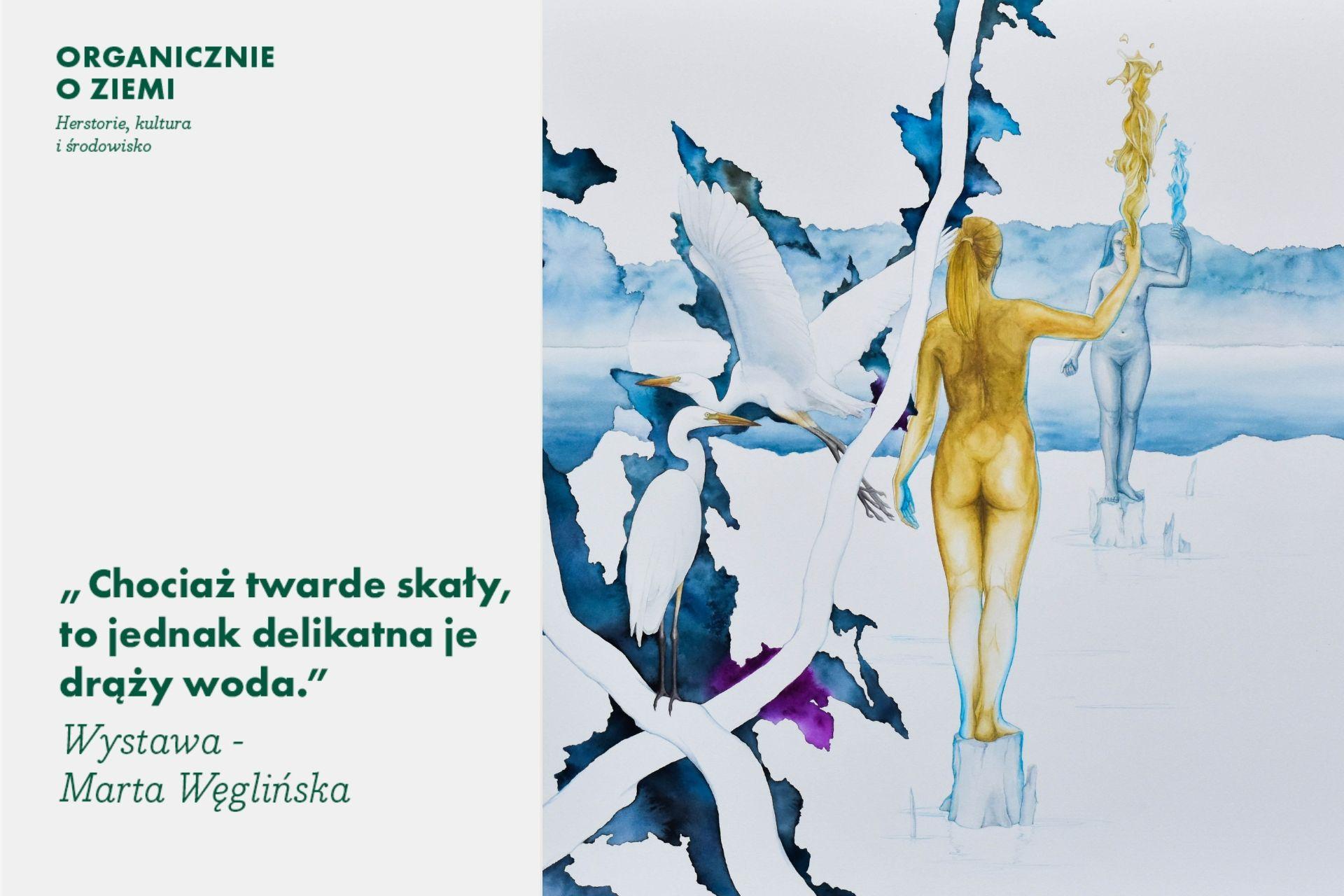
Although the rocks are hard, gentle water wears them away.
Deep, spring, mineral, surface, groundwater, shallow-subsurface, pure, dead, ancient, rainwater, snowmelt, hard, turbid, swift, azure, colorless, tasty, treacherous—these are just a few of the descriptors found under the entry for "water" in the *Dictionary of Stereotypes and Folk Symbols*. Water and its associated natural ecosystems—along with the processes and constant transformations occurring within them—are the central protagonists of this exhibition.
The concept is anchored in the human relationship with nature—a connection that is at once sensory, physical, and spiritual.
Observing the natural environment and the interplay between landscape elements—water, soil, and vegetation—forms the foundation of the entire project.
Since 2022, I have spent a great deal of time in the field, traveling alone on foot or by bicycle. I listen, touch, breathe, observe, and feel; my senses awaken quickly—often all it takes is finding myself alone on an overgrown, long-abandoned path winding along a steep lakeshore slope.
I visit remote locations—primarily protected areas that are as wild and ecologically valuable as possible: alder and riparian forests (wetland woodlands), swamps, peat bogs, spring zones, unregulated river valleys, lakes, and rocky ravines that transform into rushing torrents at certain times.
I observe nature through multiple lenses: biology, geology, religion, philosophy, and culture.
At the same time, I juxtapose this knowledge with a deeply personal, individual approach dominated by intuition and a multisensory experience of reality. Places that hold special significance for me serve as both inspiration and subjects for my photographs, paintings, and objects.
Here, figures immerse themselves in the landscape, seamlessly intertwining with the vegetation to become part of the natural space.
Human beings are subject to the same mechanisms that shape the terrain.
Water gradually carves valleys, shifts river courses, and smooths rough stones—sculpting the landscape millimeter by millimeter, or sometimes with intensified force measured in meters.
Observing the natural environment draws attention to the constant dynamic of change unfolding around us.
I resonate with the idea of correspondences between the macrocosm and the microcosm—the notion that analogous laws and principles govern both the vast and the minute.
A careful analysis of the environment can also serve as a lens through which we view our own lives from a new perspective.
In my view, artistic practice in the era of the climate crisis should point to the root causes of the problem we are currently facing.
Without understanding these underlying reasons—such as the separation of humans from nature and the dichotomy between culture and nature—it is more difficult to effectively implement changes in how we treat the natural environment in a way that resonates with society.
The approach presented in this exhibition draws upon the concept of "deep ecology," a movement founded in the 1970s by the Norwegian professor Arne Naess.
This theory integrates philosophical aspects with the realm of emotions, spirituality, and everyday life.
It calls for us to ask fundamental questions: about the causes of the climate crisis, how we wish to live, and the convictions by which we want to act.
At its ideological core, deep ecology is grounded in the belief that humans are an integral part of the Earth, rather than entities separate from it.
You can visit the exhibition from April 22 to May 31 during the opening hours of the General Dąbrowski Palace in Winna Góra.
Bio
Marta Węglińska (born in 1990 in the Lublin region) holds an MA in Intermedia (2016) and a BA in Painting (2014) from the University of the Arts in Poznań. She is a three-time recipient of the Ministry of Culture and National Heritage (MKiDN) scholarship (2015, 2010, 2008) and a winner of the MKiDN Award (2014). From 2013 to 2017, she co-ran and curated the Silverado Gallery. She is the founder of the educational and artistic initiative Kobalt Migrating Platform and a recipient of the Darmasiswa RI scholarship—a one-year international grant from the Indonesian government. Her work focuses on art and cultural education, drawing inspiration primarily from the natural environment and nature-related symbolism.
She has exhibited her work at venues including the National Museum in Jakarta, the Zachęta Project Room in Warsaw, the Central Museum of Textiles in Łódź, the Art Encounters Foundation in Timișoara (Romania), the Kunsthalle in Hanover, the WRO Art Center in Wrocław, and the Razem Pamoja Foundation in Kraków, as well as at Alt_Cph 15 (Copenhagen’s Alternative Art Fair) and the "Supermarket – Stockholm Independent Art Fair."